Section 5.6 · Further exercises · 1 of 20
Exercise 5.6.1: Two signals at one receiver
Twenty further exercises in the spirit of the problems, the worked examples and the home exercises, graded from easy to harder within two groups. Exercises 5.6.1–5.6.10 belong to the lecture: Exercises 5.6.1–5.6.2 are about phasors and the phase velocity, 5.6.3–5.6.5 about the complex permittivity and the wave number, 5.6.6–5.6.7 about the Helmholtz equation and 5.6.8–5.6.10 about power. Exercises 5.6.11–5.6.20 belong to the exercise lecture: reading time-harmonic fields, loops, mixers and receivers, power, and the medium found from measurements. They use only
and, from Section 6.1, the instantaneous and the complex Poynting vectors and , with , and the time-harmonic Poynting relation
with the time-average energy densities and (real , ). For a wave every becomes , so Faraday's law gives . A small loop of turns and area in a field of angular frequency picks up an emf of amplitude , with its normal.
Two signals at one receiver
#Two waves of the same frequency, travelling the same way, arrive at a receiver in air. There their electric fields, both along and in , are
(a) Write both phasors and add them. (b) Write the total field . (c) Moving the receiver changes the phase of relative to by any angle: what are the largest and the smallest amplitudes that can be received? (d) Find the time-average power density of each wave alone and of the sum in (b), and at the maximum and minimum of (c).
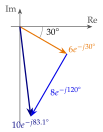
Fields of the same frequency add as phasors. Turn the sine into a cosine first, .
and :
With an extra phase on , lies between and : in phase the amplitudes add, in antiphase they subtract.
Each wave alone carries : and . The sum in (b) carries , exactly . At the maximum , at the minimum .
Turn below and watch the received amplitude swing between and .
, and .
Powers add only when the two fields are in quadrature, as here (). In general , and the cross term swings the received power between and , a factor of . This is multipath fading: a receiver moved by a fraction of a wavelength can lose almost all of its signal.
cf. Home exercise 5.6.1