Chapter 3
3 Electrostatics
Electrostatics is the physics of charges at rest, and in this chapter everything is derived from a single experimental law, Coulomb's law for the force between two point charges.
Electrostatics is the physics of charges at rest. It rests on a single experimental law, Coulomb's law for the force between two point charges. In this chapter we start from that one law and, with the mathematics of Chapter 2, derive everything else: the electric field of any charge distribution, Gauss's law, the electrostatic potential with the equations of Laplace and Poisson, and finally the behaviour of fields in insulators and around conductors, which leads to boundary conditions, images, energy and capacitance. Each of the four sections ends with its own problems and solutions.
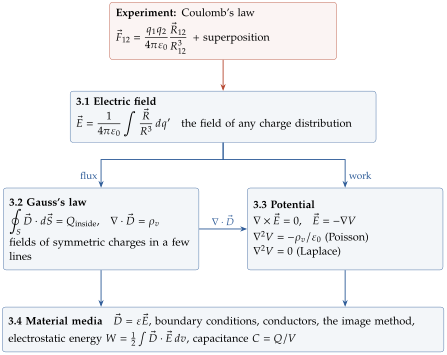
Work through the four sections in order, following the arrows of Figure 3.0.1 from Coulomb's law to material media. Each section ends with its own problems and solutions, always in the same order: Problems, Home exercises, Further exercises and Worked examples. Try each problem first and read the solution afterwards: the methods matter more than the answers.