Chapter 5
5 Maxwell's Equations
In this chapter the fields are allowed to change in time, the two pairs of static field equations merge into Maxwell's four equations, and two new terms, Faraday's law of induction and the displacement current, lead to electromagnetic waves travelling at the speed of light.
Everything in this book so far was static: charges at rest in Chapter 3, steady currents in Chapter 4. Each of the two chapters ended with a pair of field equations, one for the curl and one for the divergence of its field. In this chapter the fields are allowed to change in time, and the two pairs merge into one set of four equations. Two new terms appear. The first, in the curl of , is Faraday's law of induction, found in the laboratory in 1831 and the basis of every generator, transformer and motor. The second, in the curl of , is Maxwell's displacement current, found on paper in 1862 because without it the equations contradict one another as soon as a capacitor is charged. With both terms in place the four equations predict electromagnetic waves travelling at the speed of light, and the whole course arrives at its destination.
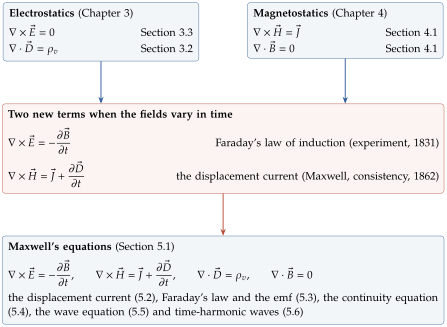
Work through Section 5.1 following the arrows of Figure 5.0.1 from the static equations to the four Maxwell equations, then the two new terms one at a time: the displacement current in Section 5.2 and Faraday's law of induction in Section 5.3. Section 5.4 shows how the conservation of charge ties them together and closes the electrodynamics part of the course. Each section ends with its own problems and solutions, in the usual order: Problems, Home exercises and Further exercises. Section 5.5, on the wave equation, and Section 5.6, on time-harmonic waves, are being written and will follow. Try each problem first and read the solution afterwards: the methods matter more than the answers.