Chapter 2
2 Mathematical Background
Electric and magnetic fields are vectors that change from point to point, and this chapter builds the small mathematical toolbox needed to describe them, starting with vectors and vector algebra.
Electric and magnetic fields are vectors that change from point to point. To describe them, and to turn experimental laws into equations we can solve, we need a small toolbox: vector algebra, three coordinate systems, three differential operators (gradient, divergence, curl) and three integral theorems. This chapter builds the toolbox step by step. Every tool is introduced with a picture of what it means before its formula, and every formula is used immediately in worked examples.
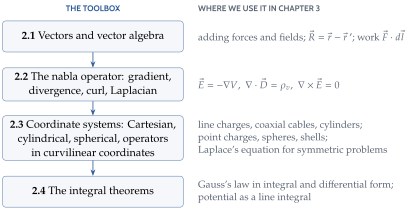
The chapter has four parts: vectors and vector algebra (Section 2.1, on this page), the nabla operator with the gradient, divergence, curl and Laplacian (Section 2.2), the three coordinate systems (Section 2.3) and the integral theorems (Section 2.4). Work through them in this order, since the toolbox is built step by step. In each section, look at the picture of what a tool means before its formula, and then follow the worked examples within the text, where every formula is used immediately. The right-hand column of the figure shows where each tool returns in Chapter 3.
2.1 Vectors and Vector Algebra
Scalars, vectors and fields, and the few rules of vector algebra (components, magnitude, unit vector, sums, dot, cross and triple products) that every later calculation of the course uses.
- the difference between a scalar and a vector, and between a scalar field and a vector field,
- how to write a vector with Cartesian components, and how to find its length and its unit vector,
- how to add, subtract and scale vectors, both with components and with arrows,
- what the dot product computes (a projection, an angle, the work of a force) and how to evaluate it, and
- what the cross product computes (an oriented area, a direction given by the right-hand rule) and how to evaluate it.
If you push a heavy box across the floor, it matters not only how hard you push but also in which direction: the same push applied sideways or downwards has a completely different effect. Quantities of this kind (a size together with a direction) are everywhere in electromagnetics. The force on a charge, the electric field around it, the flow of current in a wire and the orientation of a small piece of surface are all described by vectors. Vector algebra is the grammar with which we combine them, and this section collects the few rules we need. None of them is difficult, but every later calculation in the course uses them, so it pays to understand each one both as a formula and as a picture.