Section 2.1 · Topic 2 of 8
2.1.2 Components, magnitude and unit vector
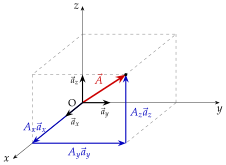
In a Cartesian (rectangular) coordinate system the three mutually perpendicular unit vectors , , point in the directions of increasing , and . A unit vector is a vector of length one, so it carries only a direction. Any vector can be written as the sum of three vectors along these directions,
where the scalars , , are the components of (Figure 2.1.2). You can think of the components as walking instructions: "go along , then along , then along ". Placing the three vectors , and head to tail brings us from the tail of to its head, and they form the edges of a rectangular box whose main diagonal is .
Magnitude
Applying Pythagoras' theorem twice (first to the right triangle in the -plane with legs and , whose hypotenuse is , then to the vertical right triangle whose legs are that hypotenuse and ) gives the length of the box diagonal:
The magnitude is never negative, and it is zero only for the zero vector .
Unit vector
Dividing a vector by its own magnitude leaves its direction unchanged and makes its length equal to one. The unit vector in the direction of is therefore
The second form, "magnitude times unit vector", separates the two pieces of information carried by a vector, and it is the form in which most field expressions of this course are written: for example the field of a point charge will be (a number) (Section 3.1). A unit vector is dimensionless, and the unit of is carried by its magnitude.
A vector is "how much" times "which way". The magnitude answers "how much" (with the unit), the unit vector answers "which way" (with no unit).