Section 2.1 · Topic 3 of 8
2.1.3 Adding, subtracting and scaling vectors
Vectors are added (or subtracted) component by component:
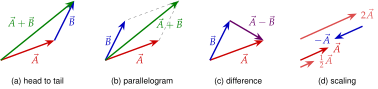
Geometrically this is the familiar head-to-tail (or parallelogram) rule of Figure 2.1.3: walk along , then along , and the arrow from the start to the end point is . Addition is commutative, (the two routes around the parallelogram end at the same corner), and associative, . The difference is . Drawn from a common tail, it is the arrow from the head of to the head of , a picture we shall use again for the displacement vector in Section 2.3.
Multiplying a vector by a scalar multiplies every component by , . It stretches the vector by the factor and reverses it if . Only quantities with the same unit can be added: a force can be added to a force, but not to an electric field.
Equation (2.1.4) works because are the same at every point of space. We shall see in Section 2.3.4 that this is not true of the cylindrical unit vectors and , and that adding cylindrical components of vectors located at different points is a classic mistake.
Adding magnitudes instead of vectors. In general : the lengths add only when the two vectors point the same way. For and we get with , not . Always add the components first and take the magnitude at the end.