Chapter 5 · Section 5.2
5.2 The Displacement Current
Ampère's law needs a second source term when currents are unsteady: the displacement current, the rate of change of the electric flux, which carries the current across a capacitor gap, produces a magnetic field like any current and competes with the conduction current in every medium.
- what the displacement current is, and why Ampère's law is inconsistent without it as soon as a current is unsteady,
- how the displacement current through a capacitor gap is the capacitor law in disguise, and what magnetic field it produces in the gap, and
- how to compare the conduction and the displacement current in a medium with the loss tangent and the crossover frequency, and when the displacement current may be dropped against the conduction current.
The second Maxwell equation, written with the new term on the right-hand side, reads
The two terms on the right stand side by side and have the same unit, , so the equation says that is also a kind of current density: it produces a circulating magnetic field exactly as the conduction current density does. It is called the displacement current density, after the old name "displacement" for .
The displacement current density is , and the displacement current through a surface is
the rate of change of the electric flux through .
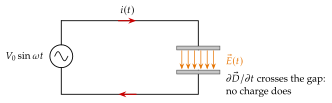
The everyday example of such a current is the current that "flows through" a capacitor in an alternating-current circuit (Figure 5.2.1). No charge ever crosses the gap between the plates, yet an ammeter anywhere in the loop reads the same current , and the circuit behaves as if the current went straight through. What goes through the gap is the changing electric flux.
Contents of Section 5.2
Start reading →- 5.2.1Why the term must be there: one loop, two surfaces
- 5.2.2The displacement current equals the conduction current
- 5.2.3Conduction or displacement? The crossover frequency
- 5.2.4Recap
- 5.2.5Problems and solutions