Chapter 5 · Section 5.4
5.4 The Continuity Equation
Charge is neither created nor destroyed: the continuity equation, which follows from Maxwell's equations, contains Kirchhoff's current law, forces the displacement current to exist and closes the electrodynamics part of the course, from Coulomb's law to the wave.
- the continuity equation in differential and in integral form, the local statement of the conservation of charge,
- why Kirchhoff's current law is its steady-state form, and how fast a conductor reaches that state,
- why charge conservation forces the displacement current to exist, and
- how the twelve lectures of the course fit together, from Coulomb's law to the wave.
Apply the divergence operator to every term of the second Maxwell equation:
The divergence of a curl is zero, , and the third Maxwell equation gives . What remains is
The integral form follows by integrating the differential form over a volume and converting the first term with the divergence theorem of Section 2.4 (Figure 5.4.1). It says that the current leaving a closed surface is the rate at which the charge inside it falls. Charge is neither created nor destroyed, it only flows: the continuity equation is the local statement of the conservation of charge.
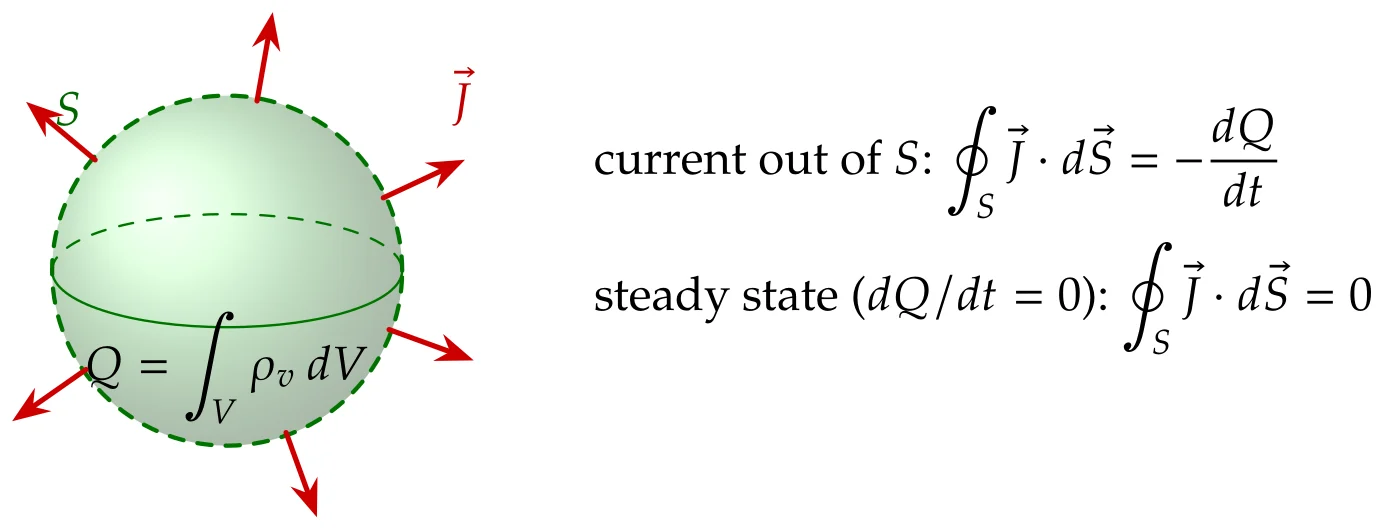
If more current flows out of a region than into it, the charge in the region must be falling at exactly that rate. There is no other place the charge can go.
Two consequences are worth keeping.
- In a steady state , so and for every closed surface. Drawn around a circuit node, this is Kirchhoff's current law, used since the first year without knowing that it is Maxwell's second equation in disguise. Exercise 5.4.1 shows how fast a conductor reaches this state: any charge placed inside it decays with the relaxation time .
- The derivation runs backwards as well, and this is the argument Maxwell needed. If we demand charge conservation, then , so and the source of , which must be divergence-free, has to be . Without the displacement current, would force at all times, that is everywhere: it would forbid a capacitor from ever charging.
A current of flows into a closed surface and none flows out. What is happening to the charge inside?
(inward), so : the enclosed charge grows by two coulombs every second, as on the plate of a capacitor being charged at .