Section 5.4 · Topic 1 of 3
5.4.1 Twelve lectures, four equations
This section ends the electrodynamics part of the course, and it is a good place to look back (Figure 5.4.2). We began with a force between two charges at rest, Coulomb's law of Section 3.1, and we end with a wave that needs no charges at all, the plane wave of Home exercise 5.1.1. Each step on the way removed one assumption. First we assumed that the charges were still: that gave the electric field, Gauss's law, the potential and the behaviour of material media and conductors, all of Chapter 3. Then we allowed charges to move but required the currents to be steady: that gave the Lorentz force, the Biot–Savart law and Ampère's law, the vector potential, inductance, magnetic energy and magnetic circuits, all of Chapter 4. Finally, in Sections 5.1 to 5.4, we dropped the assumption that the fields do not change in time, and the two halves became one subject.
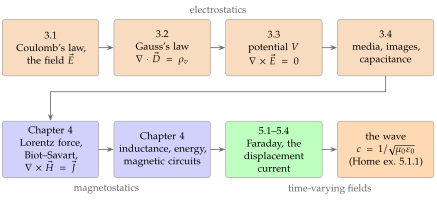
What survives all of it is remarkably compact: the pair of curl equations and the pair of divergence equations (5.1.1), together with , and for the material, and the Lorentz force for what the fields do to matter. Home exercise 5.1.1 shows that this set has a solution in empty space which is a travelling wave, and that the wave is possible only because of the displacement current: without the magnetic field of the wave would have nothing to sustain it. Exercise 5.1.2 derives the wave equation itself and computes the speed from the two constants of this book, and : the product is exactly and the speed exactly . Coulomb's constant comes from the force between charges and from the force between currents, two table-top experiments, and together they give the speed of light. This was Maxwell's evidence, in 1865, that light is an electromagnetic wave. Section 5.5 derives the wave equation in general, and Section 5.6 treats the time-harmonic waves of engineering practice.
Change and and watch , and . In vacuum is exactly m/s.
Everything in an electrical engineering degree that is not a signal or an algorithm is an approximation of these four equations: circuit theory when the device is much smaller than the wavelength, magnetic circuits when , transmission lines when one dimension is not small, and optics when the wavelength is very small. Knowing which approximation you are standing in, and when it stops being true, is what this course was for.