Section 5.2 · Topic 2 of 5
5.2.2 The displacement current equals the conduction current
Let us make the argument quantitative for a parallel-plate capacitor of plate area and spacing , filled with a medium of permittivity (Figure 5.2.3). The plate voltage is . Between the plates, with fringing neglected, the field is uniform (Section 3.4),
where is the capacitance of Section 3.4. The displacement current through any surface across the gap is therefore
which is exactly the circuit-theory law of the capacitor. The relation , used since the first year, is the second Maxwell equation applied to the gap. Home exercise 5.2.1 carries this out for a sinusoidal voltage.
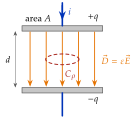
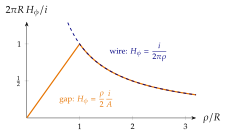
The displacement current also has a magnetic field, as a current should. Apply Eq. (5.2.5) to the dashed circle of radius centred on the axis inside the gap, where . By symmetry , and is uniform over the disc spanning the circle, so
for circular plates with . At the rim of plates of radius , and , which is the field of the wire outside: the magnetic field joins continuously, and the field of the current "through" the capacitor is the field of a current spread uniformly over the plate (Figure 5.2.3b, Exercise 5.2.1).
Think of the lines of between the plates as the continuation of the current. When grows, new lines appear in the gap at the rate , and the magnetic field circulates around the growing bundle of lines exactly as it circulates around the wire. The flux lines of carry the current across the gap.
A capacitor is charged so that its voltage rises at . How large is the displacement current through the gap?
, equal to the conduction current in the leads at the same instant. The size and shape of the plates do not matter: only does.