Section 5.2 · Topic 1 of 5
5.2.1 Why the term must be there: one loop, two surfaces
To see that the static Ampère law cannot be right for unsteady currents, consider the wire feeding a capacitor and draw a closed curve around the wire (Figure 5.2.2). The integral form of Ampère's law, obtained from by Stokes's theorem (Section 2.4),
holds for any open surface whose rim is : Stokes's theorem does not care which surface we stretch over the curve. Take two of them.
- The flat disc is cut by the wire. The current passes through it, so .
- The bag has the same rim but bulges to the right and passes between the plates of the capacitor. No wire cuts it, and no charge crosses the gap, so .
One left-hand side, , and two different right-hand sides, and . Ampère's law is inconsistent as soon as the current is unsteady. For a steady current the contradiction never arises, because a steady current cannot stop at a plate: the charge on the plate would grow without limit. The capacitor can only be charging, growing, and this is precisely the situation in which between the plates is changing.
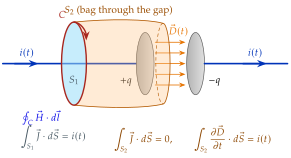
Now let us see what the changing flux amounts to. Apply Gauss's law to a closed surface drawn around the left-hand plate: it encloses the charge , so the flux of out of it is . With fringing neglected, all of this flux leaves through the gap, where it crosses the bag . Hence and
The rate of change of the electric flux through is exactly the current that the wire delivers to the plate. If, therefore, we take instead of as the source of , both surfaces give : through it is the conduction current, through it is the displacement current, and the law is consistent again.
Switch between the flat disc and the bag, and remove the Maxwell term: only with do both surfaces give .
There is a general reason behind this. The divergence of a curl is identically zero, so whatever stands on the right-hand side of a curl equation must be divergence-free. For the static law this requires , which is true only for steady currents. For the corrected source, using Gauss's law and the continuity equation of Section 5.4,
identically, whether the currents are steady or not. A divergence-free field has the same flux through every surface spanning a given curve (its field lines neither begin nor end, so the lines crossing are the lines crossing ), and the circulation of around is then well defined.
The right-hand side is the same for every surface spanning , as a curl law requires. The displacement current is the one term of the four equations that came from consistency rather than from an experiment.
Where a conduction current stops, a changing electric flux takes over, and the magnetic field cannot tell the difference. The total current, conduction plus displacement, never stops anywhere: it flows in closed loops, through the capacitor gap as well as through the wire.
Writing for a loop near a charging capacitor and then choosing the surface through the gap, which gives and no magnetic field around a wire that plainly carries a current. The static law is only consistent when . As soon as charge piles up anywhere, the displacement current must be included on every surface that passes through a region where changes.