Section 5.2 · Topic 3 of 5
5.2.3 Conduction or displacement? The crossover frequency
In a material medium both terms of Eq. (5.2.1) are present at once. A medium with conductivity and permittivity carrying the field has the conduction current density and the displacement current density :
The two terms are a quarter period apart in time, and their amplitudes are in the ratio
a number called the loss tangent of the medium. The ratio falls with frequency: every medium behaves as a conductor at low enough frequencies and as a dielectric at high enough ones. The two terms are equal at the crossover frequency
above which the displacement current dominates. Table 5.2.1 and Figure 5.2.4 give three examples, computed with .
Table 5.2.1. Three media and their crossover frequencies .
| Medium | (where ) | ||
|---|---|---|---|
| copper | |||
| sea water | |||
| wet soil |
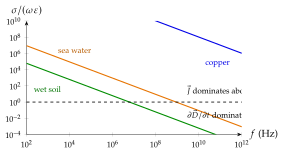
Drag the frequency marker and read off where each medium changes from conductor to dielectric.
Copper is a conductor right through the visible band, which is why the displacement current may be dropped inside metals at every frequency an electrical engineer meets. Sea water stops being a conductor near . This is why communication with submarines uses very low frequencies (VLF, to ), where the water is a good conductor and the depth to which a wave penetrates is metres rather than millimetres, while a microwave signal is absorbed within a few centimetres. Exercise 5.2.2 works out damp soil, which changes character between and .
Is sea water (, ) a conductor or a dielectric at ?
: the conduction current exceeds the displacement current by almost six orders of magnitude, and sea water is a conductor. (The same ratio at is , a dielectric with losses.)