Section 2.1 · Topic 6 of 8
2.1.6 Triple products
Two combinations of three vectors appear repeatedly. The scalar triple product equals the determinant whose rows are the components of , , :
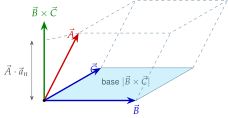
(Take the dot product of with the expanded form of (2.1.8) written for : the unit vectors of the first row are simply replaced by .) Its absolute value is the volume of the parallelepiped with edges , , (Figure 2.1.7): is the area of the base, and , the projection of on the normal of the base, is the height. Since the same volume is obtained with any face as base, the product is unchanged under a cyclic permutation, . The vector triple product obeys the "back-cab" rule
which can be checked by writing out both sides in components.
Write with the components of (2.1.8). Then
because the six products cancel in pairs ( against , and so on), and the same happens for . (In the language of triple products, is a determinant with two equal rows.) For the magnitude, square and add the three components:
Expanding, the squares give and the cross terms give . On the other hand and , so that is exactly the same expression. Hence .