Section 2.1 · Topic 5 of 8
2.1.5 The cross (vector) product
The dot product of two vectors is a number. Many physical situations, however, produce a new direction out of two given ones: a wrench turned in a horizontal plane drives a screw vertically, and a charge moving horizontally through a vertical magnetic field is pushed sideways. The cross product describes such situations.
The cross product of and is the vector
where the determinant is expanded along its first row. (In the expansion the middle term carries a minus sign, , which we have written as .) The cross product is anticommutative,
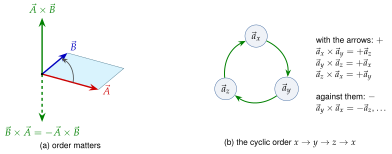
(interchanging two rows of a determinant changes its sign), it is distributive, , but it is not associative: in general . For the Cartesian unit vectors,
The cyclic order is the definition of a right-handed coordinate system: a product of two unit vectors taken in this cyclic order gives the third one, taken against it gives the third one (Figure 2.1.6b). Multiplying out with (2.1.10) (and , etc.) reproduces the expanded form of (2.1.8).
Geometric meaning of the cross product
Using the components one can verify two facts (the details are in the "Going deeper" box below): Lagrange's identity , and , i.e. is perpendicular to both factors. Hence
where is the unit vector perpendicular to both and , in the direction in which a right-handed screw advances when is turned towards through the angle (right-hand rule).
The magnitude is the area of the parallelogram with sides and (Figure 2.1.5b): its base is and its height is . So a cross product is an oriented area: a magnitude equal to an area and a direction normal to it. This is precisely how we shall represent surface elements, . Parallel vectors ( or ) have zero cross product, because the parallelogram collapses. In physics the cross product describes, for example, the torque of a force about a point and the magnetic force on a moving charge.
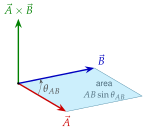
is a vector standing perpendicular to both and . Its length is the area of the parallelogram they span: largest when they are perpendicular, zero when they are parallel. Its direction comes from the right-hand rule, and swapping the factors flips it.
Getting the order or the middle sign wrong. and are opposite vectors, so the order of the factors must be kept exactly as written. When expanding the determinant, remember the minus sign in front of the term. A quick safeguard is to check at the end that the result is perpendicular to both factors, and .
(i) Find and . (ii) For which angle between two vectors is equal to ?
(i) (with the arrows of Figure 2.1.6b) and (against them). (ii) requires , i.e. .
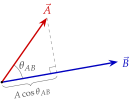
Drag the two vectors below and watch their sum and difference, the dot product as a projection and the cross product as the area of the parallelogram: make them perpendicular to see vanish, and parallel to see vanish.