Section 2.1 · Topic 4 of 8
2.1.4 The dot (scalar) product
We often need to know "how much of one vector points along another". How much of the force on a sled actually pulls it forwards? How much of the electric field crosses a surface instead of sliding along it? The dot product answers exactly this kind of question.
The dot product of two vectors is the scalar
It is commutative and distributive, , and the dot product of a vector with itself is the square of its magnitude, . For the Cartesian unit vectors,
and indeed (2.1.5) follows from these relations by multiplying out term by term: of the nine products only the three "diagonal" ones survive, because the six "mixed" products such as are zero.
Geometric meaning of the dot product
Let () be the angle between and when they are drawn from a common point. We compute the length of the third side of the triangle they form, (Figure 2.1.3c), in two ways.
- With the law of cosines of plane geometry: .
- With the dot product and its distributive law: .
The two right-hand sides must be equal, and comparing them gives
Thus the dot product is the product of the length of one vector and the projection of the other onto it (Figure 2.1.5a): is the scalar component of in the direction of . In particular each Cartesian component is a projection, , , . The sign of the dot product tells us at a glance whether two vectors point "roughly the same way", are perpendicular, or point "roughly opposite ways" (Figure 2.1.4). Three consequences are used constantly:
- (with ) means ,
- the angle between two vectors is , and
- only the part of a vector along a direction contributes to a dot product. The work done by a force over a small displacement is , and the flux of a field through a small surface element is . Both of these appear in this chapter.
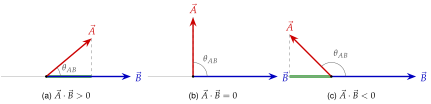
measures how much and "agree in direction", weighted by their lengths. It is largest () when they are parallel, zero when they are perpendicular and most negative () when they are antiparallel. A rope pulling a sled at an angle to the ground does work per step : only the forward part of the pull counts.
Without computing any angle, decide whether and are perpendicular. What is the scalar component of along ?
, so they are perpendicular (they are the two diagonals of a square). The scalar component along is : lies in the -plane.