Section 2.1 · Topic 1 of 8

2.1.1 Scalars, vectors and fields

A scalar is a quantity that is completely specified by its magnitude (and its unit): temperature, mass, electric charge, electric potential. A vector has both a magnitude and a direction: displacement, velocity, force, the electric field intensity. We write vectors with an arrow, , and their magnitudes either as or simply as .

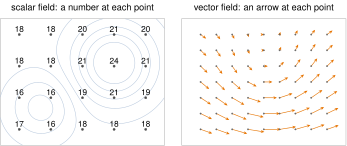
When a quantity is defined at every point of a region of space we speak of a field. A scalar field assigns a number to each point, for example the temperature in a room or the electric potential around a charged body. A vector field assigns a vector to each point, for example the velocity of the air in the room, or the electric field around the charged body. A weather map shows both kinds side by side (Figure 2.1.1): the temperature map is a scalar field, the wind map a vector field. Fields may also depend on time, but in electrostatics (Chapter 3) they do not, and in this chapter all fields are functions of position only.
A scalar field and a vector field, as on a weather map. Left: an (illustrative) temperature T(x,y) in degrees Celsius. Each dot carries one number, and the thin lines join points of equal temperature (they were computed from the same function). Right: an (illustrative) wind velocity \vec u(x,y). Each dot carries an arrow whose length is the wind speed and whose direction is the wind direction. Notice that the right-hand picture needs three numbers per point in space (two in this flat picture), the left-hand picture only one.
Figure 2.1.1. A scalar field and a vector field, as on a weather map. Left: an (illustrative) temperature in degrees Celsius. Each dot carries one number, and the thin lines join points of equal temperature (they were computed from the same function). Right: an (illustrative) wind velocity . Each dot carries an arrow whose length is the wind speed and whose direction is the wind direction. Notice that the right-hand picture needs three numbers per point in space (two in this flat picture), the left-hand picture only one.

← Back to Section 2.1 contents

Electromagnetic Fields and Waves · Prof. Gökhan Çınar© 2026 Gökhan Çınar. All rights reserved. Copyright