Section 5.6 · Further exercises · 15 of 20
Exercise 5.6.15: Finding a beacon with a rotating loop
About the further exercises of Section 5.6
Twenty further exercises in the spirit of the problems, the worked examples and the home exercises, graded from easy to harder within two groups. Exercises 5.6.1–5.6.10 belong to the lecture: Exercises 5.6.1–5.6.2 are about phasors and the phase velocity, 5.6.3–5.6.5 about the complex permittivity and the wave number, 5.6.6–5.6.7 about the Helmholtz equation and 5.6.8–5.6.10 about power. Exercises 5.6.11–5.6.20 belong to the exercise lecture: reading time-harmonic fields, loops, mixers and receivers, power, and the medium found from measurements. They use only
and, from Section 6.1, the instantaneous and the complex Poynting vectors and , with , and the time-harmonic Poynting relation
with the time-average energy densities and (real , ). For a wave every becomes , so Faraday's law gives . A small loop of turns and area in a field of angular frequency picks up an emf of amplitude , with its normal.
Finding a beacon with a rotating loop
#A radio beacon at sends a ground wave that arrives horizontally along , with (vertical), , and . A vertical loop of turns and radius turns about the -axis, and its normal is . (a) Find the emf amplitude as a function of . (b) For which is it zero, and what is its largest value? (c) The operator sets the loop off the null, or off the maximum: by how much does the reading change in each case? (d) A null is found at . Where can the beacon be?
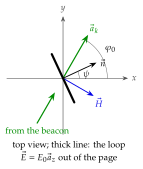
The flux through the loop is per turn, and only the angle between and changes as the loop turns. A null is sharp, because the reading changes fastest where it passes through zero.
, so
using .
Zero for or : the normal points along the direction of travel, the plane of the loop faces the beacon and lies in it. The largest value, at , is
off the null: , a clear of full scale. off the maximum: , a change of , which nobody can see.
or : the beacon lies on the line through the receiver at from , either in the direction (the wave travelling along ) or in the direction .
and : the loop is small and the field is uniform over it.
The figure-of-eight pattern has two nulls apart, so a loop alone cannot tell front from back. Aircraft direction finders add a small vertical "sense" antenna whose signal, added to that of the loop, turns the pattern into a cardioid with a single null. Two bearings from two known beacons fix the position.
cf. Home exercise 5.6.7