Section 5.6 · Further exercises · 17 of 20
Exercise 5.6.17: The power of an AM wave
About the further exercises of Section 5.6
Twenty further exercises in the spirit of the problems, the worked examples and the home exercises, graded from easy to harder within two groups. Exercises 5.6.1–5.6.10 belong to the lecture: Exercises 5.6.1–5.6.2 are about phasors and the phase velocity, 5.6.3–5.6.5 about the complex permittivity and the wave number, 5.6.6–5.6.7 about the Helmholtz equation and 5.6.8–5.6.10 about power. Exercises 5.6.11–5.6.20 belong to the exercise lecture: reading time-harmonic fields, loops, mixers and receivers, power, and the medium found from measurements. They use only
and, from Section 6.1, the instantaneous and the complex Poynting vectors and , with , and the time-harmonic Poynting relation
with the time-average energy densities and (real , ). For a wave every becomes , so Faraday's law gives . A small loop of turns and area in a field of angular frequency picks up an emf of amplitude , with its normal.
The power of an AM wave
#An AM broadcast wave in air is
with , modulation index , and . (a) Write as a sum of time-harmonic waves and give the phasor of each. Can one phasor describe ? (b) Find . (c) Find the time-average power density, and the share carried by the sidebands. (d) Find the largest field and the largest instantaneous power density.
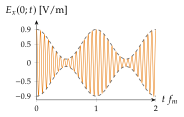
A phasor belongs to one frequency. Expand the product with into three waves, each of which travels at and has its own phasor. Cross products of different frequencies average to zero, so the average powers of the three add.
These are three waves to , at and , with and the phasors
One phasor cannot describe : has a single , and contains three.
For each wave , and does not depend on frequency, so
The averages add:
Each sideband carries , together of the power.
The envelope peaks at , where , almost five times the average.
Since , the field repeats after , and the average of over that time, computed numerically, is .
The carrier carries no information, yet it takes of the power even at , and at least for any . Single-sideband transmission, like the wave of Problem 5.6.6 with its single line at , sends only one sideband. In the receiver of Problem 5.6.6 both sidebands of the AM wave fold onto the same tone at .
cf. Problem 5.6.6