Section 5.6 · Further exercises · 19 of 20
Exercise 5.6.19: Measuring a liquid with an I/Q receiver
About the further exercises of Section 5.6
Twenty further exercises in the spirit of the problems, the worked examples and the home exercises, graded from easy to harder within two groups. Exercises 5.6.1–5.6.10 belong to the lecture: Exercises 5.6.1–5.6.2 are about phasors and the phase velocity, 5.6.3–5.6.5 about the complex permittivity and the wave number, 5.6.6–5.6.7 about the Helmholtz equation and 5.6.8–5.6.10 about power. Exercises 5.6.11–5.6.20 belong to the exercise lecture: reading time-harmonic fields, loops, mixers and receivers, power, and the medium found from measurements. They use only
and, from Section 6.1, the instantaneous and the complex Poynting vectors and , with , and the time-harmonic Poynting relation
with the time-average energy densities and (real , ). For a wave every becomes , so Faraday's law gives . A small loop of turns and area in a field of angular frequency picks up an emf of amplitude , with its normal.
Measuring a liquid with an I/Q receiver
#An I/Q receiver multiplies the probe voltage by in one mixer and by in another, and low-pass filters both products into and . (a) Show that , the phasor of . (b) Two probes, apart along the direction of travel in a nonmagnetic liquid, are read at : and . Find . (c) Find , and . (d) Show that the reading is unique if (water).
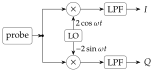
The I/Q receiver is two mixers of Problem 5.6.6 with oscillator signals in quadrature: it delivers the phasor of the probe voltage. For a wave to the phasors at the two probes are related by , so one complex division and one complex logarithm give , and gives the liquid.
and . The low-pass filters remove the terms: , and .
and :
The angle of is known only modulo : . For , and , far above any liquid. Only is possible.
With exactly, , and , the reading at probe 2.
, and the spacing was chosen below a wavelength, so for every plausible liquid. A vector network analyser does the same job with a reference channel instead of a second probe. Values of this order are typical of ethanol near (about , from its Debye relaxation near ). Water would give , and a salt solution a much larger .
cf. Problem 5.6.6