Section 5.6 · Further exercises · 8 of 20
Exercise 5.6.8: How much the power pulsates
About the further exercises of Section 5.6
Twenty further exercises in the spirit of the problems, the worked examples and the home exercises, graded from easy to harder within two groups. Exercises 5.6.1–5.6.10 belong to the lecture: Exercises 5.6.1–5.6.2 are about phasors and the phase velocity, 5.6.3–5.6.5 about the complex permittivity and the wave number, 5.6.6–5.6.7 about the Helmholtz equation and 5.6.8–5.6.10 about power. Exercises 5.6.11–5.6.20 belong to the exercise lecture: reading time-harmonic fields, loops, mixers and receivers, power, and the medium found from measurements. They use only
and, from Section 6.1, the instantaneous and the complex Poynting vectors and , with , and the time-harmonic Poynting relation
with the time-average energy densities and (real , ). For a wave every becomes , so Faraday's law gives . A small loop of turns and area in a field of angular frequency picks up an emf of amplitude , with its normal.
How much the power pulsates
#A wave in free space has the phasor , . (a) Find . (b) Find the instantaneous Poynting vector and write it as a constant plus terms at . (c) Find from (b) and from . (d) Find the range of for , and . For which amplitudes and phases would not pulsate at all?
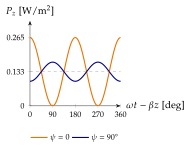
For a wave along in free space Faraday's law gives . Then multiply the real fields and use .
and with :
With : and , so
The terms average to zero: for every . From the phasors,
the same.
The part has the amplitude :
| ripple amplitude [W/m²] | range of [W/m²] | |
|---|---|---|
| to | ||
| to | ||
| to |
The ripple is smallest for , and it vanishes only if, in addition, the two amplitudes are equal: .
For the field is along a fixed direction (at from towards ), and swings between and twice its mean, as for any single linearly polarised wave.
The average power depends only on , never on the phase between the components. The phase decides how steadily it is delivered: with and equal amplitudes (circular polarisation, Section 6.1) the field vector rotates at constant length and the power flows like a d.c. current.
cf. Home exercise 5.6.3