Section 5.6 · Home exercises · 1 of 7
Home exercise 5.6.1: Phasors in both directions
Home exercises 5.6.1–5.6.3 belong to the lecture, Home exercises 5.6.4–5.6.7 to the exercise lecture.
Phasors in both directions
#-
Write the phasor of
-
Write the instantaneous form of the phasor .
-
Show that the phasor of is and that of (no constant) is .
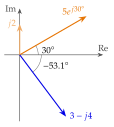
Each Cartesian component has its own amplitude and phase. Write every term as , whose phasor is . Going back, write the complex amplitude in polar form and read off .
The -term is already a cosine, with the phasor . For the -term, , so its phasor is :
, so
With and independent of , the derivative passes through the real part:
Choosing , the zero-mean antiderivative and the only one that is itself time-harmonic, the phasors are and .
At , : (a) gives and , and (b) gives .
Multiplying by advances a phasor by , dividing by delays it by : leads the field by a quarter period, lags it by a quarter period. That is why became .