Section 5.6 · Problems · 6 of 14
Problem 5.6.6: A modulated wave on a loop, and a mixer
A modulated wave on a loop, and a mixer
#An information signal of frequency is modulated with a carrier wave of frequency . The resulting wave which is propagating in air has the magnetic field component
A circular antenna with a radius of is on the -plane with its centre at the origin.
- Find the induced emf.
- There is a local oscillator with a frequency of . The induced emf and the output of the local oscillator are put into a mixer. Determine the output of the mixer and comment on the result.
Note: a basic oscillator could be an circuit with a resonance frequency of . A Colpitts oscillator is another choice.
Adapted from: B. M. Notaroš, Electromagnetics, Example 9.9.
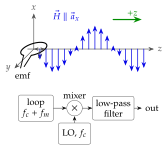
The loop does not move, so only the transformer emf of Faraday's law appears. A loop much smaller than the wavelength sees the same field all over its surface. An ideal mixer multiplies its two inputs, and shows which frequencies come out.
There is one frequency, . In air . The loop lies in the -plane, so , with the emf counted anticlockwise seen from . A stationary loop picks up only the transformer emf, . An antenna for a wave of wavelength is "small" when : then on the loop.
The flux through the disc of radius is
For a small loop, all over (the origin is at the centre):
The minus sign only fixes the phase for the chosen sense of the loop: reversing the terminals reverses it. The emf is a property of the whole loop, so it cannot depend on : the phase is integrated out, and what survives is the amplitude, proportional to , and the frequency of the wave.
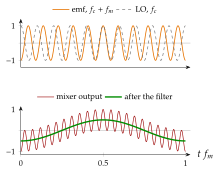
The local oscillator gives . An ideal mixer multiplies its two inputs:
A low-pass filter with its cut-off between and keeps the second term:
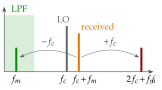
The mixer shifts the received line down by : the carrier is removed and the message at is recovered. This is the down-conversion in every radio receiver (Figure 5.6.18). An oscillator off by would deliver the tone at , so the local oscillator must be accurate.
Units: .
Without the small-loop step the integral can be done exactly. Write . The part odd in cancels over the disc, and the even part gives, with the Bessel function met again in Section 7.4,
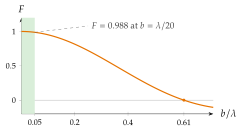
Figure 5.6.17 shows against . The small-loop result is good to up to , where , and a loop of radius picks up nothing at all: positive and negative half waves of then cancel over its area.