Section 5.6 · Problems · 8 of 14
Problem 5.6.8: A damped wave: phasor, medium and power
A damped wave: phasor, medium and power
#In an infinite, source-free, simple and non-magnetic medium, the electric field component of a monochromatic electromagnetic wave is measured as
- Find the frequency, phase velocity and wavelength of this wave.
- Determine the phasor expression of the electric field.
- Find the wavenumber , and by the help of this, determine the conductivity and relative permittivity for this medium.
- Calculate the average power passing through a surface on plane in direction.
Adapted from: M. N. O. Sadiku, Elements of Electromagnetics, Problem 10.9.
The field is a sine, the time enters with a minus sign, and there is a factor . Bring it to the form first: then every part is a reading. The Helmholtz equation gives , Faraday's law gives , and the power.
The phasor rules use cosines with , so first
Then , so , the factor gives , and means travel towards , decaying.
, so
Helmholtz: , so
Of the two roots , the wave that decays along needs , so . Compare with , where and :
from Faraday's law, , with
The complex Poynting vector of Eq. (5.6.27), with :
with on the plane .
With the intrinsic impedance , that is at , the relation gives the same , and .
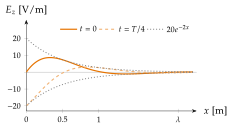
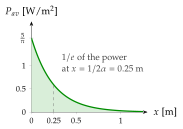
: conduction dominates. lags by , so also has a reactive part, . Over one wavelength the amplitude falls to , strongly damped, as suggests. The power density falls as , twice the field rate: to at and to at (Figure 5.6.20). The rest has turned into heat.