Section 5.6 · Worked examples · 1 of 2
Worked example 5.6.1: Heating water at 2.45 GHz
Two short calculations tied to the applications. They use only , and the heat density , and no new physics. A good way to use them: read the given quantities, produce the formula from the corresponding application yourself, and only then put the numbers in. Constants: , , and .
Heating water at 2.45 GHz
#cf. Application 5.6.2
Given. Water at , , , , from the Debye model of Application 5.6.2. Field amplitude in the water . Heat capacity of water .
Find. (a) and , (b) , the wavelength in water and the power depth , (c) the depth where the power has fallen to , (d) the heat density and the heating rate.
Adapted from: S. J. Orfanidis, Electromagnetic Waves and Antennas, Example 2.6.2.
Polarisation losses act as a conductivity , Eq. (5.6.14). The wave number follows from , the power falls as , and the heat density is , Eq. (5.6.26).
and :
and , so
at .
For a low-loss medium Eq. (5.6.22) gives , close to the exact , and , within .
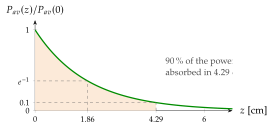
Inside water the wave is times shorter than in air and loses of its power in the first (Figure 5.6.27): a thick piece of food is heated from the outside in, and its core by conduction. The heating rate matches an oven that puts about into a litre of water.