Section 5.5 · Further exercises · 5 of 10
Exercise 5.5.5: The field of a coaxial line
About the further exercises of Section 5.5
Ten further exercises in the spirit of Problems 5.5.1–5.5.6, the home exercises and the worked examples, graded from easy to harder. Exercises 5.5.1–5.5.2 are about travelling pulses, Exercises 5.5.3–5.5.5 about the wave equation itself, Exercises 5.5.6–5.5.8 about potentials and gauges, and Exercises 5.5.9–5.5.10 about retarded potentials. They use only the equations listed at the head of this subsection. All media are nonmagnetic.
The field of a coaxial line
#Between the conductors of a coaxial line () filled with PE () the field is
(a) Show that . (b) Show that the scalar does not satisfy for any . (c) Write and and show that each satisfies the scalar wave equation if and only if . (d) Find , and at .
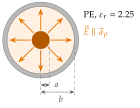
The mistake box of Section 5.5.3 in a concrete case. Use the cylindrical divergence and Laplacian, Eq. (2.3.63) in Section 2.3, for (a) and (b), and convert to Cartesian components for (c).
In cylindrical coordinates
Write with . The scalar Laplacian in cylindrical coordinates gives
since and . With :
which cannot vanish for all , whatever is.
, so
The functions and are harmonic in the plane, . Hence and
and the same for . The vector field satisfies the vector wave equation although its cylindrical component does not satisfy the scalar one: the extra term in (b) is exactly the term of the vector Laplacian, .
, , .
, and .
This is the TEM field of the coaxial line (Section 7.5). It travels at the speed of a plane wave in the filling, independently of the radii and , which is why the delay of a cable depends only on its insulation (Application 5.5.1). In cylindrical coordinates only obeys the scalar wave equation directly.
cf. Problem 5.5.3