Section 5.5 · Worked examples · 2 of 3
Worked example 5.5.2: A call via a geostationary satellite
About the worked examples of Section 5.5
Three short calculations tied to the applications. They use only , the delay and the of the retarded potentials, and no new physics. Numerical constants: , Earth radius , all media nonmagnetic. A good way to use them: read the given quantities, produce the formula from the corresponding application yourself, and only then put the numbers in.
A call via a geostationary satellite
#Given. Earth radius . A geostationary satellite at the altitude , a LEO satellite at . Two ground stations see the satellite at an elevation angle .
Find. (a) the shortest hop (stations directly below the GEO satellite), (b) the slant range and hop delay at , and the time from a question to its answer, (c) the hop via LEO at , (d) the GPS range error of a clock error.
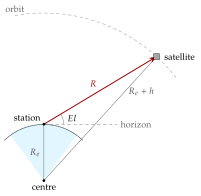
A hop is the signal going up and coming down, so its delay is the sum of the two slant ranges divided by . The slant range follows from the triangle formed by the centre of the Earth, the station and the satellite (Figure 5.5.22). The angle at the station is , and the law of cosines gives
Up and down, each :
, , :
A question sent there and the answer sent back need two hops: .
, .
.
For the formula gives , case (a). A lower elevation can only lengthen the path, and .
Half a second between question and answer makes people talk over each other: voice traffic left GEO for fibre, and LEO is almost times faster here (). GPS satellites carry atomic clocks, and the receiver solves for its own clock error as a fourth unknown next to its three coordinates.
cf. Application 5.5.2