Section 6.3 · Home exercises · 3 of 4
Home exercise 6.3.3: Submarine communication at ELF
Submarine communication at ELF
#Repeat Problem 6.3.6 at the ELF frequency Hz: the same incident field ( kV/m rms in air), the same receiver threshold ( nV/m rms) and the same seawater (, S/m).
- Find the skin depth and at the surface.
- Find the maximum depth of communication.
- At which frequency would the maximum depth be m? (Both and depend on : solve numerically.)
Adapted from: B. M. Notaroš, Electromagnetics, Problem 10.14.
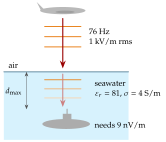
At Hz, : seawater is an even better conductor than at kHz, and the good-conductor formulas of Problem 6.3.6 apply. Both factors scale as : , so , and .
Write . Then and with
and m is solved by the iteration . Starting from it gives Hz.
At kHz: m, , and m . At kHz the same formula returns the m of Problem 6.3.6 .
Going from kHz to Hz costs dB at the surface ( falls with ) but cuts the attenuation in the water from to dB/m, and the depth grows twelvefold. The price is the antenna: at Hz the free-space wavelength is km, and the transmitters that were used for this purpose fed ground antennas tens of kilometres long and still radiated only watts. ELF links carry a few characters per minute, enough to tell a submarine to come up to periscope depth.