Section 6.1 · Problems · 10 of 11
Problem 6.1.10: \vec E from \vec H, and an elliptical wave
from , and an elliptical wave
#In a lossless medium for which , , and
- determine the relative permittivity and the angular frequency,
- find the corresponding electric field,
- determine the polarisation of the wave (type, handedness, axial ratio),
- find the time-average power density.
Adapted from: M. N. O. Sadiku, Elements of Electromagnetics, Example 10.3.
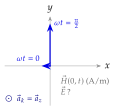
Both components vary with : the wave travels towards with . The impedance gives , gives , and , the inverse of for a transverse field, gives the electric field term by term. The polarisation follows from the tip of at .
: , . From ,
With and ,
and multiplying by (, ):
Integrating in time and dividing by , has the amplitude , as found.
At , :
| (V/m) | (V/m) | |
|---|---|---|
The tip moves from to , a rotation about . The components are unequal, in time quadrature and aligned with the axes, so the ellipse has its axes along and :
With the handedness test: , so , , and : LH.
The two linear parts are orthogonal and carry power independently:
From : .
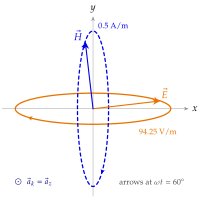
turns with : from () to (), also about , also left-handed, with its major axis along . At every instant and . As swings between and , the instantaneous power density pulses at between and around its mean .