Section 6.1 · Problems · 5 of 11
Problem 6.1.5: The Doppler sweep of a satellite pass
The Doppler sweep of a satellite pass
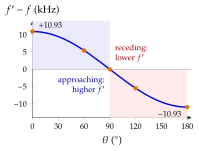
#A small satellite in a low earth orbit moves with and transmits a beacon at . During a pass the angle between its velocity and the line from the satellite to a ground station changes from nearly (rising, approaching) to nearly (setting, receding).
- Find the received frequency shift for , , , and .
- Over what frequency range must the receiver be tuned during a pass?
- How large is the error of the first-order formula compared with ?
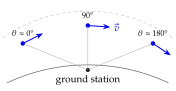
The satellite is a moving source: by Eq. (6.1.69), so the shift is the fixed amount times . The exact classical formula , , differs by the series terms
The scale of the shift is
and :
| (kHz) | |
|---|---|
From to : a range of about , wider than the channel of a narrow-band beacon (a few kHz). The station has to track the frequency during the pass.
, so the first-order formula misses at most
Exactly: at and at .
The shift is positive while the satellite approaches () and changes sign at closest approach, as it must. A car at heard on would shift by only , a GPS satellite, whose radial speed reaches about , by at . At the relativistic corrections are of the same negligible size as .
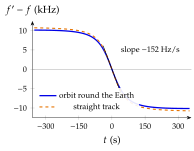
Seen in time, a pass gives an S-shaped curve: flat near the horizons and steepest at closest approach (Figure 6.1.28). For an overhead pass at the height , with the satellite moving on a straight line, the distance is with counted from closest approach, and , so near
for . A real orbit curves round the Earth: the satellite moves on a circle of radius about the Earth's centre (), which reduces the rate at closest approach by the factor , to , and limits the shift at the horizon to (the Earth's rotation is neglected here). Either way the beacon slides through at about to per second. Measuring during one pass gives the time of closest approach and the distance at that instant: this is how the Transit system, the first satellite navigation, located ships.