Section 6.2 · Further exercises · 1 of 13
Exercise 6.2.1: One soil, two survey frequencies
Thirteen further exercises in the spirit of the problems, the worked examples and the home exercises, graded from easy to harder within each group. Exercises 6.2.1–6.2.3 are about lossy media and the loss tangent, Exercises 6.2.4–6.2.5 about good conductors and the skin effect, Exercises 6.2.6–6.2.8 about plasmas and the group velocity, and Exercises 6.2.9–6.2.13 come from the exercise lecture and mix all three. They use only the equations listed at the head of this subsection, together with and , .
One soil, two survey frequencies
#Moist sandy soil has , , . (a) At what frequency are the conduction and displacement currents equal? Over which frequencies is the soil a good conductor () and over which a low-loss dielectric ()? (b) A low-frequency induction survey works at . Find the skin depth and the depth at which the field is down. (c) Repeat (b) for a radar at with the low-loss formula, and find the wavelength in the soil.
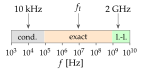
falls as , so the frequency alone moves the same soil from one class to the other. Classify first, then use the matching short formula.
, so and
, a good conductor:
, low-loss. With ,
The exact formulas give at and at , the same to four figures. The low frequency reaches twenty times deeper but sees only objects of the size of its wavelength in the soil. The radar resolves centimetres but stops within a few metres. Every subsurface method is a compromise between these two ends of the same soil.
cf. Problem 6.2.1