Section 6.2 · Further exercises · 9 of 13
Exercise 6.2.9: Is half an ounce of copper enough at 28 GHz?
About the further exercises of Section 6.2
Thirteen further exercises in the spirit of the problems, the worked examples and the home exercises, graded from easy to harder within each group. Exercises 6.2.1–6.2.3 are about lossy media and the loss tangent, Exercises 6.2.4–6.2.5 about good conductors and the skin effect, Exercises 6.2.6–6.2.8 about plasmas and the group velocity, and Exercises 6.2.9–6.2.13 come from the exercise lecture and mix all three. They use only the equations listed at the head of this subsection, together with and , .
Is half an ounce of copper enough at 28 GHz?
#Printed circuit boards use copper foil () of thickness ("half-ounce" foil). A 5G front end works at . (a) Find the skin depth and the surface resistance at . (b) At what frequency is the skin depth equal to the foil thickness? How many skin depths thick is the foil at , and how far down (in dB) is the field at its back face? (c) Show that the fraction of the Joule loss that occurs within the depth below the surface is . Evaluate it at for (the rms roughness of standard foil) and (very-low-profile foil), and at for . (d) Within what depth do of the losses occur at ?
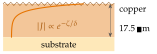
In a good conductor the current density decays as with the depth , so the Joule loss density decays as . Everything follows from .
when . At the foil is skin depths thick, and the field at the back is down by : the back face carries nothing.
The loss per unit area between the surface and the depth , divided by the total,
At , gives and gives . At (), gives .
gives .
at is , the familiar statement that most of the current flows within one skin depth, and the depth is the depth of the field, as it must be for a power fraction of . At practically all the current flows inside the micro-roughness of the copper, which lengthens its path: measured losses of standard foil exceed the smooth-surface by up to a factor of two. The thickness of the foil, by contrast, could be a hundred times smaller without any electrical effect.
cf. Worked example 6.2.2