Section 6.2 · Problems · 8 of 8
Problem 6.2.8: Decibel attenuation of a microwave oven wall
Decibel attenuation of a microwave oven wall
#Stainless steel (, and ) is used as the wall of a microwave oven at the standard frequency for microwave cooking, . Calculate the attenuation factor in dB of a -mm thick wall, and evaluate its shielding effectiveness. Find also the skin depth and the depth at which the field has dropped to .
Adapted from: B. M. Notaroš, Electromagnetics, Problem 9.31.
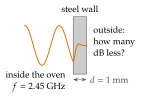
Classify the steel with the loss tangent. If it is a good conductor, , and the attenuation of the field over the thickness is .
, so : a good conductor, and .
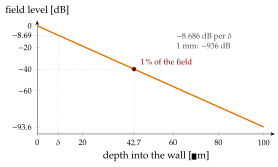
It is skin depths thick: , and
One per cent of the field () is left at the depth .
Absorption alone gives . The reflection at the surface between air and steel adds more: , and the usual estimate (Section 6.3) gives about . The wall is, for all purposes, a perfect shield.
The exact has , equal to the good-conductor to five digits. Rounding to before exponentiating gives and , unrounded and . The cited source's version of this wall has , which gives and . Austenitic stainless steel (type 304, for example) is practically nonmagnetic, , as assumed here.
The leaks of an oven are its openings, the door seal and the perforated window, whose holes of a few millimetres are tiny against , so the fields do not pass them either. The wall thickness is chosen for strength, not for shielding. Compare the water inside the oven: (Worked example 6.2.1) against in the steel. The same law decides whether the food heats and whether the wall leaks.