Section 7.8 · Problems · 1 of 5
Problem 7.8.1: Modes of a rectangular cavity
Modes of a rectangular cavity
#An air-filled rectangular cavity has , and .
- Find the resonant frequencies and the modes up to .
- Which mode is dominant, and how far above it is the next resonance? Which modes are degenerate?
- A coaxial probe is inserted through the centre of the top wall (, ). Which of the modes of (a) can it excite?
Adapted from: M. N. O. Sadiku, Elements of Electromagnetics, Problem 12.30.
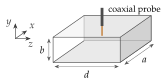
In air with the sides in cm. Since alone already gives , every mode with lies at or above, so the search is short. For (c), a vertical probe couples only to at its tip, so it drives a mode only if there.
, , .
Modes with (TE only, ):
Modes with :
The next ones, TE and TM at and TM at , are beyond the range. TM needs , so no TM mode has .
is the smallest side, so the dominant mode is TE at . The next resonance, TE at , is () higher. Degenerate pairs: TE and TE (because , so ), TE and TM (always, for ), TE and TE (again ).
From Eqs. (7.8.11) and (7.8.10),
At the top wall , and at , the product vanishes unless and are both odd. Hence
- excited: TE (), TE and TM (), TE (),
- not excited: TE, TE, TE (a node of at the probe), TE, TE (: no ), TM (: only ).
, : the guide cutoff of TE plus one half guide wavelength along , as in Eq. (7.8.9).
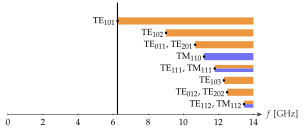
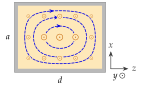
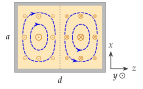
Within the range of (a) the probe also drives TE at , since : three half-waves along put a maximum of back at the centre. Seen from the probe the cavity is clean from up to times that frequency, a wider spurious-free range than the mode chart alone suggests (Figure 7.8.22).