Section 7.4 · Topic 1 of 11
7.4.1 The circular pipe and its boundary conditions
The guide of Figure 7.4.1 is a perfectly conducting tube whose inner wall is the cylinder . It is filled with a homogeneous lossless medium , (air in most guides), and the wave travels along . The natural coordinates are the cylindrical ones of Section 2.3, , because the wall is then the surface on which one coordinate is constant, and every boundary condition involves one coordinate only.
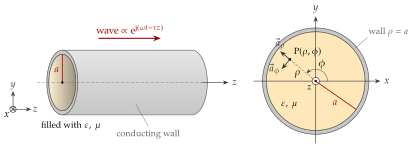
On a perfect conductor the tangential electric field vanishes. The tangential directions on the wall are and , so
The radial component is normal to the wall and may stay nonzero there: it ends on a surface charge (the normal of the wall points into the guide, along ). Since is zero in the metal and is continuous, the normal magnetic field vanishes at the wall as well. We shall see that this second condition is satisfied automatically once Eq. (7.4.4) is.
In Cartesian coordinates the circle mixes both coordinates, and a condition such as “ on the wall” becomes a relation between and that changes from point to point. In cylindrical coordinates it reads at , for every at once. Choosing coordinates in which the boundary is a coordinate surface is the key step of every boundary-value problem, exactly as the planes and were for the rectangular guide.