Section 7.4 · Topic 3 of 11
7.4.3 Bessel functions and their zeros
Figure 7.4.2 shows , and . All of them oscillate, with an amplitude that decreases as . starts at , all the others at . The zeros are what matter for the waveguide, because the wall conditions will put the wall at a zero of (TM) or of (TE). We write
for the -th zero of and of its derivative. Table 7.4.1 lists the first ones. Other books write and , or .
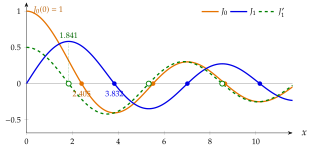
Table 7.4.1. The first zeros of the Bessel functions (first table) and of their derivatives (second table). Since , the zeros coincide with (the root of is not counted).
For large the asymptotic form of the box above, , shows that the zeros become nearly apart: the Bessel functions behave more and more like the sines of the rectangular guide, with an amplitude that decays because the circumference grows with and the same power is spread over a longer ring.
Use the asymptotic form to estimate the third zero of and compare with the table.
for , that is . For : , against the exact , an error of . Even for the estimate is only about below .