Section 7.5 · Worked examples · 1 of 1
Worked example 7.5.1: Which coaxial cable up the mast?
A short calculation tied to Application 7.5.1, with the TEM and TE results of this section. Constants: m/s, , copper S/m. Read the given quantities, pick the formulas yourself, and only then put the numbers in.
Which coaxial cable up the mast?
#Given. An access point at the foot of a mast feeds an antenna m up through RG-58 (, mm) or RG-213 (, mm), both with polyethylene (, ) and copper conductors.
Find. (a) The loss over m at GHz and the fraction of the power reaching the antenna. (b) The same at GHz. (c) The TE limits. (d) The thickest polyethylene cable still single-mode at GHz, and its loss.
and over a length the fraction of the power arrives.
, m/s. RG-58: mm, mm, . RG-213: mm, mm, .
At GHz: m, rad/m, Np/m dB/m for both cables.
At GHz grows by and by (to dB/m). RG-58: dB/m, dB, arrives. RG-213: dB/m, dB, arrives.
RG-58: GHz. RG-213: GHz.
Single-mode at GHz requires mm, with for . Hence mm, mm, an RG-58-size cable. At GHz m and its loss is dB/m, dB over m.
: for RG-58 and for RG-213 (its stranded inner conductor makes it nominally ). The cable of part (d) has GHz, exactly at the limit.
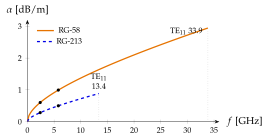
The fat cable halves the loss in dB but stops at GHz. Braided cables lose to times more than these smooth-copper figures. At GHz no cable reaches up a mast: millimetre-wave radios sit at the antenna and are fed by optical fibre.
cf. Application 7.5.1