Section 7.2 · Home exercises · 2 of 4
Home exercise 7.2.2: The TE_1 mode as two plane waves
The TE mode as two plane waves
#An air-filled parallel-plate guide with carries the TE mode at , with .
- Write as the sum of two uniform plane waves and give their wave vectors.
- Find the angle between these waves and the axis.
- Show that and , and evaluate , , , .
Adapted from: D. K. Cheng, Field and Wave Electromagnetics, 2nd ed., Example 10-4.
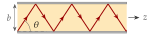
Write the sine with Euler's formula. Each exponential is a uniform plane wave whose wave vector can be read off. Its length must be , which fixes the angle.
With and ,
two plane waves with , one travelling obliquely downwards, the other upwards. Numerically , and .
, so each is an ordinary plane wave in air, and the angle to the axis satisfies
The wavefronts of each plane wave are spaced apart along . Along the axis, which makes the angle with , they are spaced : this is , consistent with . The energy of each wave travels along its ray at , and its component along the axis is . Since ,
and .
Each plane wave hits a plate at the angle of incidence with parallel to the plate (perpendicular polarisation, Section 6.4). The conductor reflects it with , and the two waves cancel on the plates, which is the boundary condition at and .