Section 5.6 · Topic 1 of 11
5.6.1 Monochromatic waves
If the time dependence of an electromagnetic wave is sinusoidal, each Cartesian component of or at the point can be written in the form
where stands for any one of the six components and
- is the amplitude, in for and for ,
- is the angular frequency or pulsation, in ,
- is the phase, and its part that depends on position,
- is the period, in , and the frequency, in .
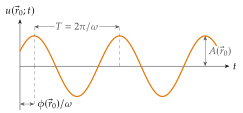
Such a wave is called monochromatic, a word borrowed from optics, where one frequency is one colour. At a fixed point the field is an ordinary sinusoid of time (Figure 5.6.1): it oscillates between , repeats every , and its first maximum is delayed by after . All the dependence on position is in the two functions and .
Any signal in time is a sum of sinusoids, a Fourier series if it is periodic and a Fourier integral if it is not. In a linear medium, one in which , and do not depend on the field, Maxwell's equations are linear, so each sinusoid travels on its own, at its own , without disturbing the others. Solve the problem for a single , and the response to any signal follows by superposition. This is exactly how circuits are analysed with phasors and impedances, and it is why everything in this section is written for one frequency.