Section 5.6 · Topic 2 of 11
5.6.2 Phase velocity and wavelength
A point of constant phase, a crest of the wave for instance, is a point where
As time goes on, this point must move. Let it move by while the time advances by . The phase stays the same, so its total change vanishes,
The surfaces const are the wave fronts, and is normal to them (Section 2.2). Along the normal, and , so the front advances by in the time . This speed is the phase velocity.
The surfaces of constant phase of the wave of Eq. (5.6.1) move along with the phase velocity
For a wave that depends on one coordinate only, and
In a lossless medium (no conductivity, ) the wave equation of Section 5.5 fixes this speed to
which is the speed of light in free space.
Follow one crest. The phase velocity is how fast it moves, and it moves at right angles to the wave fronts. The faster the phase changes with position (the larger ), the slower the crest has to move to keep up with the clock .
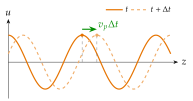
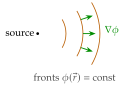
Figure 5.6.2 shows both statements. On the left, a wave at two instants: the crest has moved by to . On the right, the fronts of a wave that spreads from a small source: points along the radius, and so does the motion of the fronts. Along any other direction the crests cross a line at a larger apparent speed, a fact worked out in Exercise 5.6.2. This is why Eq. (5.6.2) uses the magnitude , the largest rate of change of the phase, which gives the smallest of all apparent speeds.
Two pictures of the same wave are useful (Figure 5.6.3). Watched at a fixed point, the field repeats every period . Photographed at a fixed instant, it repeats in space every wavelength , the distance over which the phase grows by . In a lossy medium the snapshot also decays with distance, inside an envelope that we shall find in Section 5.6.8. In one period a crest advances by exactly one wavelength, so .
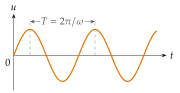
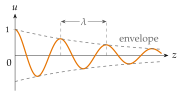
counts radians per second and counts radians per metre. Divide one by the other and you get metres per second: the phase velocity. The frequency belongs to the source and never changes from one medium to another. The wavelength belongs to the medium: where the wave is slower, it is shorter by the same factor.
Read , , , and the relative permittivity of a lossless nonmagnetic medium off the field .
, so . , so and . From Eq. (5.6.4), , close to PTFE.
The number in front of is in , not in , and the number in front of is in , not . Forgetting the in either place gives a frequency or a wavelength that is wrong by a factor of . A good check is that and must give the same number.