Section 5.6 · Topic 3 of 11
5.6.3 The electromagnetic spectrum
All electromagnetic waves obey the same Maxwell equations, from the field of a power line to the gamma rays of a PET scanner. Only the frequency differs, or, equivalently, the free-space wavelength . Figure 5.6.4 lays out twenty-two decades of frequency with some of their uses.
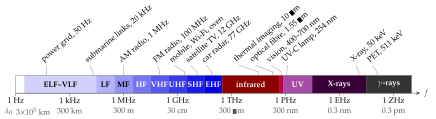
The International Telecommunication Union names the radio bands by decades: band runs from to , from VLF (, –) to EHF (, –). Above the radio bands the infrared reaches up to about , visible light occupies the narrow window from to (wavelengths from to ), the ultraviolet extends to about and X-rays to about .
The equations are the same everywhere on the spectrum, but the hardware scales with the wavelength. A wave is long, so a power line is electrically short and circuit theory suffices. An FM wave is long, which is the size of a car aerial, and the optical carrier of a fibre is long. From light upwards the photon energy matters too, and the classical field picture of this book must be supplemented by quantum physics.
The radio spectrum is a shared and finite resource. The ITU Radio Regulations, whose international Table of Frequency Allocations goes back to the Atlantic City conference of 1947, assign every band to services, and national regulators license the users. Table 5.6.1 lists the bands of Figure 5.6.4 with their free-space wavelengths and their typical users.
Table 5.6.1. The ITU radio bands, their free-space wavelengths and typical services.
| Band | Typical services | ||
|---|---|---|---|
| VLF (4) | 3–30 kHz | 100–10 km | submarine links, navigation |
| LF (5) | 30–300 kHz | 10–1 km | time signals (DCF77 at 77.5 kHz), long-wave broadcasting |
| MF (6) | 0.3–3 MHz | 1 km–100 m | AM broadcasting (531–1602 kHz in Europe), maritime |
| HF (7) | 3–30 MHz | 100–10 m | short-wave broadcasting, amateur radio, RFID at 13.56 MHz |
| VHF (8) | 30–300 MHz | 10–1 m | FM broadcasting 87.5–108 MHz, air band, digital radio |
| UHF (9) | 0.3–3 GHz | 1 m–10 cm | TV, mobile phones, GPS (1575.42 MHz), Wi-Fi 2.4 GHz, ovens |
| SHF (10) | 3–30 GHz | 10–1 cm | 5G at 3.5 GHz, Wi-Fi 5 GHz, satellite TV (10.7–12.75 GHz), radar |
| EHF (11) | 30–300 GHz | 10–1 mm | car radar 76–81 GHz, 60 GHz links, radio astronomy |
Why does the band matter? Three reasons stand out.
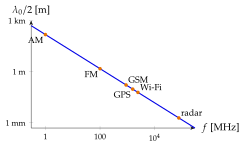
- Antenna size follows . A resonant wire antenna is about half a wavelength long: the current on it is then one half of a standing wave, and the antenna looks like a resistor to the transmitter. An AM mast is therefore a tower, while a radar antenna fits on a chip (Figure 5.6.5).
- Bandwidth grows with the carrier. An AM channel is wide, a Wi-Fi channel to .
- Propagation changes with frequency: ground wave in the LF and MF bands, sky wave reflected by the ionosphere in the HF band (Section 6.2), line of sight from VHF upwards.
| Service | ||
|---|---|---|
| AM radio | 1 MHz | 150 m |
| FM radio | 100 MHz | 1.5 m |
| GSM 900 | 900 MHz | 16.7 cm |
| GPS L1 | 1575.42 MHz | 9.5 cm |
| Wi-Fi, oven | 2.45 GHz | 6.1 cm |
| car radar | 77 GHz | 1.95 mm |
Some bands are left free for unlicensed industrial, scientific and medical (ISM) use: , , , (in the Americas), , and . Microwave ovens, Wi-Fi and Bluetooth all share the band at (Application 5.6.2 and Worked example 5.6.2).
How long is a half-wave dipole for a key fob or remote sensor?
. This is why such devices use shortened, coiled or printed antennas instead of a straight half-wave wire.