Section 5.6 · Topic 4 of 11
5.6.4 Phasors
Calculating with sines and cosines is tedious: every derivative turns one into the other, and adding two of them requires trigonometric identities. Euler's formula offers a way out, because . The wave of Eq. (5.6.1) can then be written as
The factor is common to every quantity at the same frequency. Everything that distinguishes one field from another, its amplitude and its phase, sits in the complex function in front of it.
The phasor of the time-harmonic quantity is the complex function of position
It keeps the amplitude, , and the phase, . The time factor is suppressed and must be put back to return to the time domain.
Now differentiate with respect to time. The phasor does not depend on , and the real part of a complex function can be taken before or after the differentiation, since is a linear operation:
The derivative of is again a time-harmonic quantity at the same frequency, and its phasor is .
A phasor is a snapshot of a rotating arrow, taken at . Differentiating in time multiplies the arrow by : it stretches it by and turns it forward by , because the derivative of a cosine peaks a quarter period earlier than the cosine itself.
Figure 5.6.6 gives the picture behind the name. The complex number is an arrow of length that turns anticlockwise at . Its shadow on the real axis is the physical quantity , which therefore swings between and as a cosine. The phasor is the position of the arrow at : it fixes where the arrow starts.
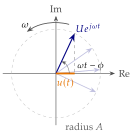
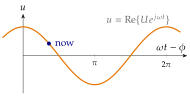
Watch the arrow's shadow trace the cosine below, here for the wave of Problem 5.6.1. Then drag the observation point along the middle plot and see the phasor turn back by per metre.
Table 5.6.2 collects the rules used in practice. The second line follows from : a sine is a cosine delayed by a quarter period, and its phasor carries the factor . Repeating Eq. (5.6.8) gives the second derivative, and reading it backwards gives the integral, provided the integration constant is chosen zero, the only choice that keeps the integral time-harmonic (Home exercise 5.6.1). A vector field is handled component by component: , where the phasor has three complex components, each with its own amplitude and phase. In this book the phasor and the time-domain field carry the same symbol, and the argument tells them apart: or is a phasor, or the real field.
Table 5.6.2. The phasor rules, with .
| Time domain | Phasor |
|---|---|
| , three complex components |
The rule uses a cosine reference. A field does not have the phasor : that phasor describes , a field a quarter period early. Write the sine as a cosine first, , and the phasor is (Problem 5.6.14). The factor is the sine.
Phasors add, subtract and differentiate exactly like the fields they represent, because these operations are linear. They do not multiply: . The product of two time-harmonic fields contains a constant and a term at , and has no phasor at . Power, the product of and , needs its own rule, , derived in Section 6.1.
Write the phasor of . Which way does the wave travel?
. The term and the term carry the same sign, so a crest const moves towards as grows. A phasor marks a wave towards , a phasor a wave towards .