Section 5.6 · Topic 6 of 11
5.6.6 Complex permittivity and the loss tangent
Put the current of Eq. (5.6.11) into 2. The conduction current and the displacement current both multiply , and they merge into a single term:
The source-free part of Ampère's law has the same form as in a lossless dielectric, with the real permittivity replaced by a complex one.
A lossy medium is a lossless one with a complex permittivity. Every formula derived for a lossless medium holds in a lossy one once is replaced by . The imaginary part, , measures the loss.
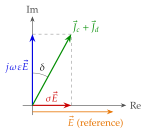
The loss tangent was met in Section 5.2.3, Eq. (5.2.10), as the ratio of the amplitudes of the conduction and the displacement current densities. Phasors show that it is also an angle (Figure 5.6.7a). Take the phasor of as the real reference. The conduction current is in phase with it, the displacement current leads it by , and the total current leads by , where is the loss angle. In a perfect dielectric and the current leads by a full quarter period, as in an ideal capacitor. In the complex plane of Figure 5.6.7b, is an arrow at the angle below the real axis.
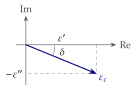
Conduction is not the only loss. In a dielectric such as water, the molecular dipoles follow the alternating field with a lag, as if rubbing against their neighbours, so the polarisation, and with it , lags behind . The permittivity itself then has a negative imaginary part, and in Eq. (5.6.13) collects both effects. Whatever its origin, acts like a conductivity, the effective conductivity
The microwave oven of Application 5.6.2 runs entirely on such polarisation losses, in water whose static conductivity is negligible.
Good dielectric or good conductor?
Whether a material is a conductor or an insulator is not a property of the material alone. For a constant and the loss tangent falls as , and the medium changes character at the crossover frequency of Eq. (5.2.11) in Section 5.2. Table 5.6.3 names the three regimes and Figure 5.6.8 shows four materials.
Table 5.6.3. The three regimes of a medium, set by the loss tangent at the working frequency.
| Loss tangent | The medium is | Approximation |
|---|---|---|
| a good (low-loss) dielectric | ||
| a quasi-conductor | keep exactly | |
| a good conductor |
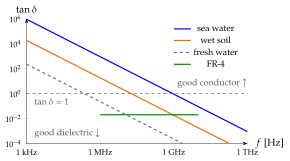
The crossover lies at :
- sea water (, ): ,
- wet soil (, ): . Soils vary widely with their moisture: Table 5.2.1 in Section 5.2 took and found ,
- fresh water (, ): ,
- copper (): , a conductor at every radio frequency.
For a circuit-board laminate the losses are mostly polarisation losses, so data sheets quote itself, about for FR-4, nearly flat from to . Then is constant and grows in proportion to (Home exercise 5.6.2).
Is fresh water a good dielectric at ?
: yes, as far as conduction goes, and . (At microwave frequencies the polarisation loss of water takes over, as Application 5.6.2 shows.)