Section 5.6 · Further exercises · 10 of 20
Exercise 5.6.10: Power delivered by a radiating current sheet
About the further exercises of Section 5.6
Twenty further exercises in the spirit of the problems, the worked examples and the home exercises, graded from easy to harder within two groups. Exercises 5.6.1–5.6.10 belong to the lecture: Exercises 5.6.1–5.6.2 are about phasors and the phase velocity, 5.6.3–5.6.5 about the complex permittivity and the wave number, 5.6.6–5.6.7 about the Helmholtz equation and 5.6.8–5.6.10 about power. Exercises 5.6.11–5.6.20 belong to the exercise lecture: reading time-harmonic fields, loops, mixers and receivers, power, and the medium found from measurements. They use only
and, from Section 6.1, the instantaneous and the complex Poynting vectors and , with , and the time-harmonic Poynting relation
with the time-average energy densities and (real , ). For a wave every becomes , so Faraday's law gives . A small loop of turns and area in a field of angular frequency picks up an emf of amplitude , with its normal.
Power delivered by a radiating current sheet
#The plane in free space carries a time-harmonic surface current with (real). It radiates plane waves away from the sheet on both sides: on either side (symmetry), with for . (a) Use the boundary condition to find . (b) Find on both sides. (c) Find the power the sheet delivers per unit area, , and check the Poynting relation for a thin box enclosing of the sheet. (d) What changes if the space on both sides is a lossless dielectric with ?
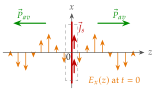
The sheet is the only source, and the magnetic boundary condition of Section 4.2.3 ties the jump of at to . The source term of the time-harmonic Poynting relation, , becomes for a sheet, and must equal the power leaving the box.
Region 1 is , region 2 is . At the sheet , and :
On each side and are in phase with :
away from the sheet on both sides.
At the sheet , so the sheet delivers
and the outward flux through the two faces of the box is per of sheet. The box is thin, so it stores and dissipates nothing.
Every step holds with : , and the power is halved, in all, to each side.
The minus sign in is essential: the field at the sheet opposes the current, so and the source delivers power. Had been along , the sheet would absorb power like a resistive load.
The sheet sees a load of per square, the two half-spaces in parallel, each with the wave impedance , as shows. A broadside array of many antennas fed in phase approximates such a sheet. For the same current, a medium of lower impedance takes less power, while at constant voltage it would take more.
cf. Problem 5.6.5