Section 5.6 · Further exercises · 11 of 20
Exercise 5.6.11: Four ways to write a wave
About the further exercises of Section 5.6
Twenty further exercises in the spirit of the problems, the worked examples and the home exercises, graded from easy to harder within two groups. Exercises 5.6.1–5.6.10 belong to the lecture: Exercises 5.6.1–5.6.2 are about phasors and the phase velocity, 5.6.3–5.6.5 about the complex permittivity and the wave number, 5.6.6–5.6.7 about the Helmholtz equation and 5.6.8–5.6.10 about power. Exercises 5.6.11–5.6.20 belong to the exercise lecture: reading time-harmonic fields, loops, mixers and receivers, power, and the medium found from measurements. They use only
and, from Section 6.1, the instantaneous and the complex Poynting vectors and , with , and the time-harmonic Poynting relation
with the time-average energy densities and (real , ). For a wave every becomes , so Faraday's law gives . A small loop of turns and area in a field of angular frequency picks up an emf of amplitude , with its normal.
Four ways to write a wave
#In a lossless nonmagnetic medium four waves of the same frequency are written as (, , fields in )
(a) For each, give the direction of travel and the phasor. (b) Find , and . (c) Evaluate each field at , , once from the phasor and once from the formula.
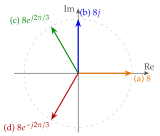
Rewrite each field as with a positive amplitude and . Then means travel to (phasor ) and travel to (phasor ). The tools are , and .
In (c) the cosine is even, so .
, and .
, so and . From the phasors, at gives
From the formulas: , , and , the same.
The direction never depends on sine or cosine, nor on the order in which and are written, only on whether and have opposite signs () or the same sign ().
The phasors (b) and (c) differ only by the factor : wave (c) is wave (b) advanced by , that is by . A negative amplitude is never left in a phasor: it is a phase of .
cf. Problems 5.6.8, 5.6.11, 5.6.14