Section 5.6 · Further exercises · 12 of 20
Exercise 5.6.12: A phasor that spirals
About the further exercises of Section 5.6
Twenty further exercises in the spirit of the problems, the worked examples and the home exercises, graded from easy to harder within two groups. Exercises 5.6.1–5.6.10 belong to the lecture: Exercises 5.6.1–5.6.2 are about phasors and the phase velocity, 5.6.3–5.6.5 about the complex permittivity and the wave number, 5.6.6–5.6.7 about the Helmholtz equation and 5.6.8–5.6.10 about power. Exercises 5.6.11–5.6.20 belong to the exercise lecture: reading time-harmonic fields, loops, mixers and receivers, power, and the medium found from measurements. They use only
and, from Section 6.1, the instantaneous and the complex Poynting vectors and , with , and the time-harmonic Poynting relation
with the time-average energy densities and (real , ). For a wave every becomes , so Faraday's law gives . A small loop of turns and area in a field of angular frequency picks up an emf of amplitude , with its normal.
A phasor that spirals
#A small probe is moved along through a nonmagnetic liquid in which a wave travels along . A vector voltmeter records the phasor every centimetre. From one point to the next the phasor turns clockwise by and its length drops by 10 %. (a) Which way does the wave travel? (b) Find , , , and the distance of the field. (c) Find , and of the liquid.
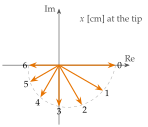
A wave travelling to has the phasor : its angle falls by and its length is multiplied by per metre. Read and from one step, then gives the material.
The angle falls (a clockwise turn) as grows, which is with : travel to . The length falls in the same direction, as it must in a passive medium.
One step is :
and . With ,
Twelve steps make one wavelength (), and over them the length falls to .
Without the loss the same would mean : ignoring overestimates by , since , not , measures . This is the principle of the free-space and probe methods used to measure liquids and biological tissue.
cf. Problems 5.6.7, 5.6.8, 5.6.14