Section 5.6 · Further exercises · 13 of 20
Exercise 5.6.13: The image station
About the further exercises of Section 5.6
Twenty further exercises in the spirit of the problems, the worked examples and the home exercises, graded from easy to harder within two groups. Exercises 5.6.1–5.6.10 belong to the lecture: Exercises 5.6.1–5.6.2 are about phasors and the phase velocity, 5.6.3–5.6.5 about the complex permittivity and the wave number, 5.6.6–5.6.7 about the Helmholtz equation and 5.6.8–5.6.10 about power. Exercises 5.6.11–5.6.20 belong to the exercise lecture: reading time-harmonic fields, loops, mixers and receivers, power, and the medium found from measurements. They use only
and, from Section 6.1, the instantaneous and the complex Poynting vectors and , with , and the time-harmonic Poynting relation
with the time-average energy densities and (real , ). For a wave every becomes , so Faraday's law gives . A small loop of turns and area in a field of angular frequency picks up an emf of amplitude , with its normal.
The image station
#A superheterodyne AM receiver uses a loop of turns and radius . Its mixer is followed by a band-pass filter at the intermediate frequency , and the local oscillator is tuned above the wanted station, . (a) For a station at , find and the frequencies that leave the mixer. (b) Which other frequency also reaches the IF filter? (c) The wanted station arrives with , a station on the frequency of (b) with . Find both emf amplitudes. (d) How much must a filter in front of the mixer attenuate the second station so that it is below the wanted one at the IF?
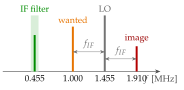
A mixer multiplies, so a line at and the oscillator at give and . Every input line with passes the IF filter, and there are two of them. The loop emf is , proportional to .
. The mixer output holds and , and the IF filter keeps .
as well: . Its other product, , is filtered out.
, and the loop is small ( at ):
The mixer treats both lines alike, so the ratio at the IF equals the ratio of the emfs, , that is . To bring the image to the pre-selector must attenuate it by more than the wanted station.
: the emf ratio is the ratio of .
A loop favours higher frequencies (), so it does nothing against an image that lies above the wanted station: here a station half as strong arrives almost as strong as the wanted one. That is why the tuning capacitor of an AM radio tunes the antenna circuit and the local oscillator together: the antenna circuit is the pre-selector. In Problem 5.6.6 the local oscillator sits at itself, and the image of is .
cf. Problem 5.6.6, Home exercise 5.6.7