Section 5.6 · Further exercises · 4 of 20
Exercise 5.6.4: A leaky capacitor
About the further exercises of Section 5.6
Twenty further exercises in the spirit of the problems, the worked examples and the home exercises, graded from easy to harder within two groups. Exercises 5.6.1–5.6.10 belong to the lecture: Exercises 5.6.1–5.6.2 are about phasors and the phase velocity, 5.6.3–5.6.5 about the complex permittivity and the wave number, 5.6.6–5.6.7 about the Helmholtz equation and 5.6.8–5.6.10 about power. Exercises 5.6.11–5.6.20 belong to the exercise lecture: reading time-harmonic fields, loops, mixers and receivers, power, and the medium found from measurements. They use only
and, from Section 6.1, the instantaneous and the complex Poynting vectors and , with , and the time-harmonic Poynting relation
with the time-average energy densities and (real , ). For a wave every becomes , so Faraday's law gives . A small loop of turns and area in a field of angular frequency picks up an emf of amplitude , with its normal.
A leaky capacitor
#A parallel-plate capacitor has plates of area , apart, filled with a dielectric of and at (fringing neglected). (a) Starting from , show that the capacitor is a conductance in parallel with a capacitance , and that . (b) Find , and the equivalent parallel resistance. (c) A voltage of amplitude is applied: find the current phasor and the average power dissipated, and check it against .
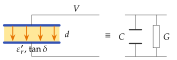
Between the plates is uniform. The total current density, conduction plus displacement, is . Integrate it over the plate area to get the terminal current.
With over the area ,
With ,
and . From the field: , and the volume is , so
The current leads the voltage by , and : the loss angle of Figure 5.6.7 is the angle by which the capacitor falls short of an ideal one.
The dissipation factor that a component bridge reports for a capacitor is exactly of its dielectric. The reactive power is times the real power, the circuit picture of the imaginary part of .
cf. Problem 5.6.5