Section 5.5 · Topic 10 of 12
5.5.10 Retarded potentials
In the static case the potentials of given sources are the integrals of Chapters 3 and 4 (Figure 5.5.9),
where is the field point , runs over the source points in the region , and is the volume element there. These are the solutions of the two Poisson equations and (Section 4.1). In the dynamic case the solutions of the wave equations Eq. (5.5.44) are called the retarded potentials.
with ( in free space). They solve the inhomogeneous wave equations Eq. (5.5.44) and, for sources that conserve charge, satisfy the Lorenz gauge.
The only change from the static integrals is when the sources are taken. The static integrals use the sources now. The retarded integrals use each source element at the retarded time , earlier by the time a signal needs to travel from that element to . Every source point has its own retarded time.
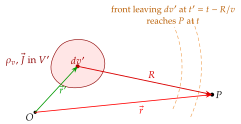
Take a single point charge at the origin, , and try , which depends on only. For a function of alone the Laplacian in spherical coordinates, Eq. (2.3.64) in Section 2.3, can be written . Here is a function of , so and
away from the charge, satisfies the homogeneous wave equation. It is an outgoing spherical wave, d'Alembert's divided by . Close to the charge, where is negligible against the time in which changes, , the potential of a static point charge, which satisfies Poisson's equation with the point source . The source term on the right of Eq. (5.5.44) is therefore matched as well. A general charge distribution is a superposition of point charges , each contributing with its own distance and its own delay , and the sum is the integral Eq. (5.5.49). The same argument, component by component, gives . That these and also satisfy the Lorenz gauge is shown in Home exercise 5.5.3 and, for a short current element, in Exercise 5.5.10.
What the retardation means
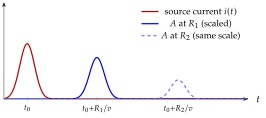
Figure 5.5.10 follows a short pulse of current at the source to two points at the distances and . Three facts can be read from it.
- What a source element does at is felt at the distance only at : the potentials travel at the speed of the wave. Nothing at all happens at before has elapsed.
- The factor is the static one: the amplitude of the potentials falls as , not faster. That slow decay is what makes radio possible over large distances.
- For a sinusoidal source of angular frequency the delay is a phase lag , with the wavelength .
When can we forget it? If the whole region of interest is small compared with , the phase lag is small everywhere in it, , and the static formulas Eq. (5.5.48) hold at every instant with the present values of the sources. This quasi-static regime is the domain of circuit theory: at , and , so a laboratory, a building and even most power networks are small. At , is only (Problem 5.5.6), and at the frequencies of mobile radio a few centimetres.
The wave equations are unchanged if is replaced by , and they also admit the advanced potentials, with the sources taken at : a field that arrives before its cause. They are discarded on physical grounds, because effects follow their causes. The retarded solution is the one that is zero everywhere until the sources are switched on.
A mobile phone transmits at to a base station away. What is the delay, and by how many periods does the field at the base station lag behind the current in the phone's antenna? Is the link quasi-static?
, which is periods. Far from quasi-static: , and the distance is about times that.
A radio signal is the field of the retarded potentials of the current in the transmitting antenna: it arrives at the distance only later. On the ground this is one microsecond per and nobody notices. In space it is the dominant delay of the link (Figure 5.5.11). For a hop from one ground station up to a satellite and down to another station, and for a range measured from a delay,
- GEO, the geostationary orbit at above the equator. The satellite seems fixed in the sky and can be served by fixed antennas, but one hop up and down takes at least . A question and its answer need two hops: about half a second of silence in a telephone call.
- LEO, a low orbit near . The one-way delay is only at the zenith and at elevation. This is why internet constellations fly low, at the price of thousands of satellites, since each one is in view of a station for a few minutes only.
- GPS, at , away at the zenith. Here the receiver measures the delay of the signals of several satellites and converts it into ranges, delay. One nanosecond of timing error is of position error.
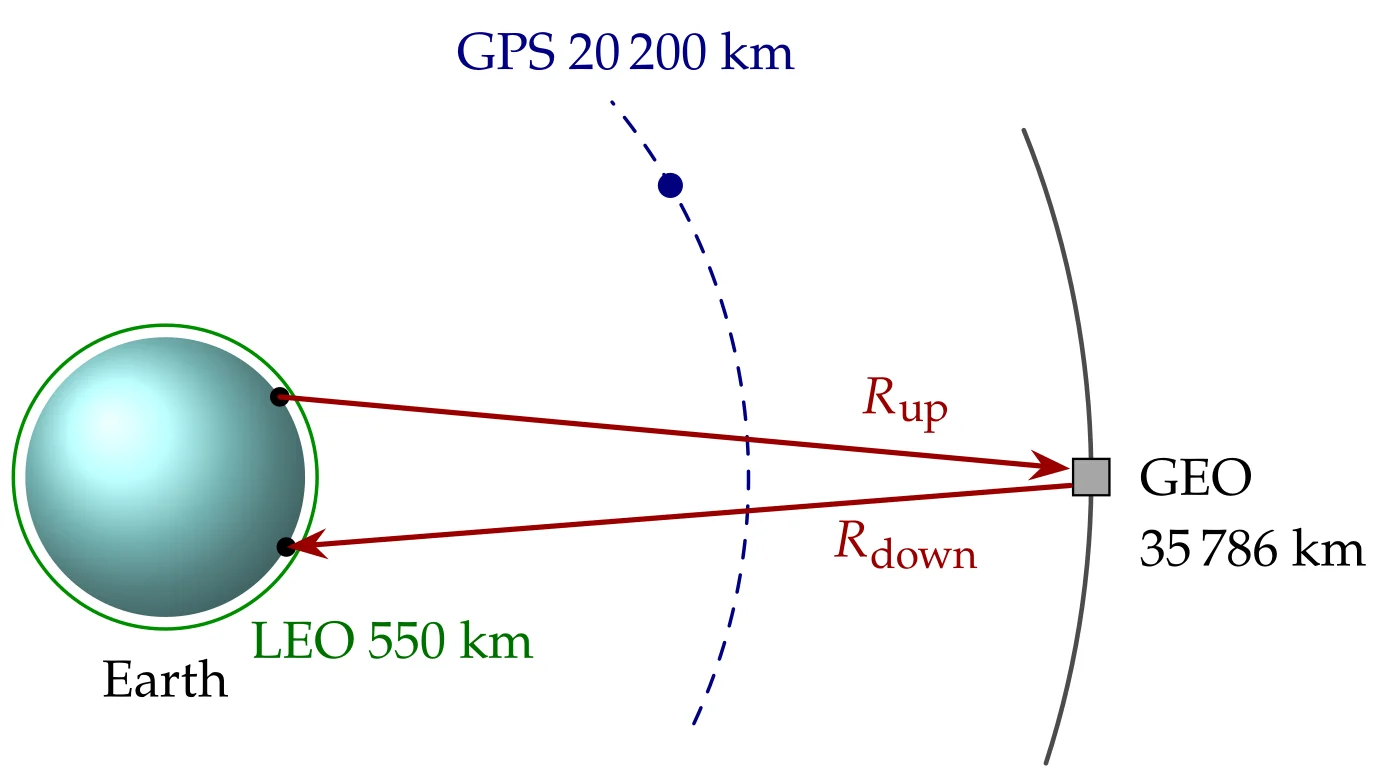
Typical numbers. The slant range from a station that sees a GEO satellite at elevation is , so a hop between two such stations takes and a question with its answer more than half a second (Worked example 5.5.2). The atmosphere adds a little: the ionosphere, whose delay depends on frequency, adds metres of equivalent path (at times tens of metres), which dual-frequency receivers remove by comparing two carriers, and the troposphere about at the zenith, which is modelled.
Digital radio (DAB) and digital terrestrial television (DVB-T) cover a country with many transmitters on one frequency, a single-frequency network. All transmitters send the same symbols at the same instant, synchronised by GPS. A receiver hears every transmitter, each one retarded by its own (Figure 5.5.12). The signal is cut into long OFDM symbols, each preceded by a guard interval , a copy of the end of the symbol. The receiver starts its processing window at the end of the guard interval of the first copy. As long as the later copy arrives within , it only adds to the wanted signal, and the condition is
A later copy spills into the next symbol and acts as interference.
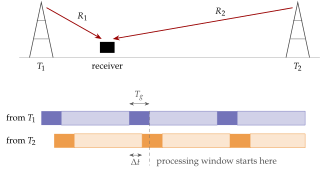
Table 5.5.3 gives the guard intervals of two common systems and the largest path difference that they absorb. The spacing of the transmitters of a network is planned from such numbers, a few tens of kilometres.
Table 5.5.3. Guard intervals of single-frequency networks and the path difference they absorb.
| System | (largest ) | |
|---|---|---|
| DVB-T, 8k mode, guard | ||
| DVB-T, 8k mode, guard | ||
| DAB, mode I |
The 1/R of the potentials helps. A distant transmitter is not only late but also weaker. Far from the antennas the fields, like the retarded potentials, fall as , so two equal transmitters at and arrive with the amplitude ratio , that is (Worked example 5.5.3). Exercise 5.5.9 shows what happens on one frequency without the digital safeguards: the two signals interfere and a moving receiver passes through deep fades.
Table 5.5.4. The applications of this section.
| Application | Physics used | Worked out in |
|---|---|---|
| Signals on a chip, a board and a cable | , | Worked example 5.5.1, Exercise 5.5.2 |
| Light-speed delay in satellite links | delay of the retarded potentials | Worked example 5.5.2 |
| Retardation in radio broadcasting | delay and amplitude | Worked example 5.5.3, Exercise 5.5.9 |