Section 5.5 · Topic 9 of 12
5.5.9 Gauge freedom
The potentials are not unique. Let be any scalar function and define
Since the curl of a gradient vanishes, . For the electric field, using that and commute,
The change Eq. (5.5.45) of the potentials, with an arbitrary , is a gauge transformation. It leaves and unchanged. A condition that selects among the equivalent pairs, such as Eq. (5.5.41), is a gauge.
Only and are measurable (through the force on a charge), so and describe the same physics (Figure 5.5.8). The Lorenz gauge uses this freedom. Suppose a pair does not satisfy it, so that . Then the new pair has , and choosing as a solution of
makes it zero: the new pair satisfies the Lorenz gauge. Such a always exists, since Eq. (5.5.47) is a wave equation with a known source, of the kind solved in Section 5.5.10.
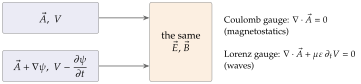
Two common choices. The Coulomb gauge is the one of magnetostatics (Section 4.1). In it obeys Poisson's equation at every instant, as if the charges were static, and all the retardation sits in . The Lorenz gauge Eq. (5.5.41) treats and alike and is the one used for waves. Even the Lorenz gauge does not fix the potentials completely: any that satisfies the homogeneous wave equation can still be added (Exercise 5.5.6).
Consistency. The wave equations Eq. (5.5.44) were derived assuming the gauge. Home exercise 5.5.3 shows that this costs nothing: the Lorenz gauge is consistent with the conservation of charge , which Maxwell's equations contain anyway. Problem 5.5.5 shows the other side of the freedom: a pair of potentials that looks like a travelling wave but describes no field at all.
Concluding from a nonzero or that a field is present, or reading as the voltage between and . A gauge transformation changes both without changing anything measurable. A potential difference is a voltage only in a description in which contributes nothing along the path (Exercises 5.5.6 and 5.5.7). Always derive and before interpreting.
What do the Lorenz gauge and the equations for the potentials become when nothing depends on time?
With the Lorenz gauge becomes , the Coulomb gauge of magnetostatics, the wave equations become Poisson's equations and , and : exactly the left column of Table 5.5.2.