Section 5.5 · Topic 2 of 12
5.5.2 The wave equation for E, step by step
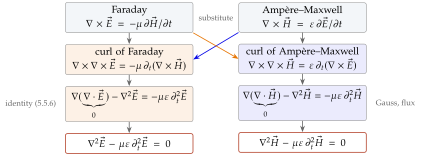
The two curl equations are first order in space and in time, and each contains both fields. To get an equation for alone we take the curl of the first one, which produces , and then replace by the second one. Four steps do it.
Step 1. Take the curl of Faraday's law. Apply to both sides of . The constant comes out. The curl contains derivatives with respect to , , only, and these commute with because the coordinates of a point do not depend on time:
Step 2. Substitute the generalised Ampère law. In the source-free region , so
has disappeared. The price is a second derivative in time, and the displacement current is the reason it is there: without the right-hand side would be zero.
Step 3. Expand the double curl. The vector identity of Section 2.2,
valid for any twice differentiable vector field , turns the left-hand side of Eq. (5.5.5) into
Step 4. Use Gauss's law. In a source-free region , the gradient term drops out, and what is left is .
In a source-free, simple, lossless medium the electric field obeys
The Laplacian measures how the field bends in space, the second time derivative how it accelerates in time. The equation says that the two are proportional everywhere: where the field is curved in space, it accelerates in time. This is the equation of a vibrating string, written for a vector in three dimensions.
Write the two components of that enter the component of the double curl,
Then
Add and subtract and collect:
The and components follow by cyclic exchange . In curvilinear coordinates the identity is used the other way round, as the definition of the vector Laplacian (Section 2.3).
Notation. is the Laplacian of Section 2.2, also written , the symbol used in the lecture slides. On a vector in Cartesian coordinates it acts component by component,
because the Cartesian unit vectors are the same at every point.
Check the units. has the units , the units of . The equation itself announces a speed,
and we shall see in Section 5.5.4 that it is the speed with which every disturbance travels. In free space and , the speed of light.